


I watch people chase their dreams—attaching themselves to the pursuit of the perfect partner, a high-powered job, or financial stability. There is nothing inherently wrong with these desires, yet believing that their fulfillment will be the source of lasting happiness can be misleading.
When I was younger, I lived the dreams of youth. I idealized romantic love, strove for success in my career, and aspired to be the best mother I could be. Desire propelled me forward and helped me achieve many things, yet the seeking self was never truly content. What I eventually learned was that the striving itself—the journey, the act of doing—taught me far more than the outcomes ever could. In fulfilling my dharma, the lessons were richer than the goals. Failure cultivated resilience, disappointment led to detachment, and detachment revealed a different, subtler kind of love.
Through it all, what burned brightest was not the achievement but the deeper quest beneath it. Slowly, my focus shifted away from tangible milestones toward internal qualities that felt more enduring and true.
Some now say I’ve become pessimistic because I no longer chase external goals or attempt to attract what I desire. But I feel I’ve become more realistic. True positive thinking is not clinging to an ideal that has yet to manifest, nor believing that the fulfillment of desire will bring happiness. True optimism is recognizing God’s grace in everything—especially when circumstances are difficult. Seeing grace even when obstacles feel overwhelming is an optimism that never betrays us.
How often do our dreams truly fulfill us? We may get the job or the partner we longed for, only to discover they cannot satisfy a deeper hunger. Grace allows us to recognize the abundance already present in each moment, even amid struggle.
Recently, I was speaking with a friend whose external life appears smooth—especially in terms of work and finances. Opportunities seem to arrive effortlessly for him. He once said, “I must have done something good in my last life to be where I am now.” He understands his circumstances as part of his karmic path and meets his life with gratitude, giving back through service.
I noticed myself wanting his situation, having endured so many years of struggle and survival. As my mind drifted toward comparison, I paused and reminded myself: the other man’s grass always seems greener.
Perhaps his grass is greener. Maybe he planted those seeds lifetimes ago, while I am still planting mine. I smiled, reflecting on the ongoing dance between destiny and free will that often occupies my thoughts. We are all dealt a hand of cards at birth. How we play that hand matters. It isn’t all luck. There are choices to be made with wisdom, discernment, and care—even when we don’t know what the next card will be.
The phrase “the other man’s grass is greener” can either soothe complacency or awaken responsibility. If we accept that it may be true, we stop complaining, take ownership of where we stand, and begin planting the seeds that will one day grow into our own green grass.
One thing I have noticed through my yearly travels to India is a deep sense of acceptance—especially among villagers and those living in poverty. There is often a quiet peace in how hardship is held, a way of seeing life that is less rooted in comparison or complaint. Life is understood through the lens of dharma and karma, and this perspective shapes how people meet their circumstances. I wonder if the saying , the others mans grass is greener even exists. Their way of seeing is different.

When we travel through India and spend time with local villagers and spiritual monks who live simply, their vision of life becomes contagious. There is a joy present that cannot be bought with money—a joy born of simplicity, meaning, and inner alignment. It is subtle, humble, and profoundly alive.
I would love for my friends to join me in India this year to experience firsthand the wisdom that flows through people’s everyday lives—wisdom that exists even amidst struggle and poverty. There is something deeply mystical in the way life is lived: without a consumer mentality, without constant wanting, but with an embodied understanding of the sacred dance between karma and dharma. This way of living—simple, devotional, and free from complaint—offers a quiet yet powerful teaching for those of us shaped by Western culture.
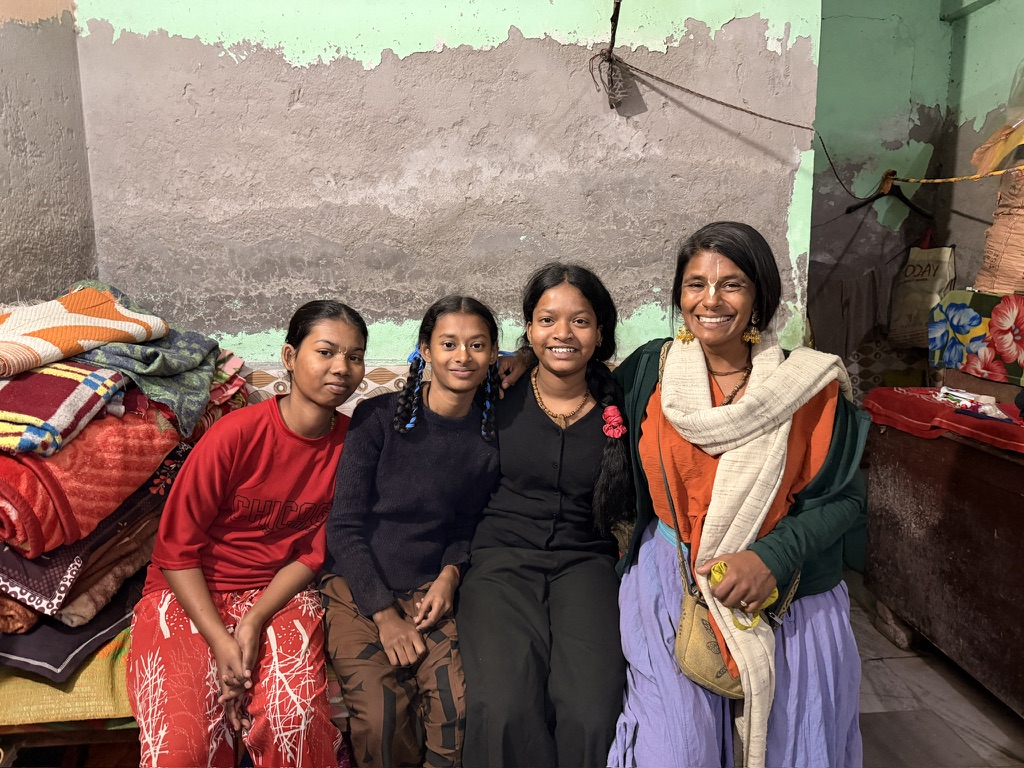
This is a picture of 2 girls that i sponsor and take care of in India – i went to their tiny home . They joy, love and gratitude touched me deeply
.

Leave a comment